In the Name of Allah, the Most Gracious, the Most Merciful!

Welcome with the peace and blessings of Allah be upon you! Where there is Allah, there is Islam... and Allah says: 'And hold fast, all of you together, to the Rope of Allah (i.e. this Koran), and be not divided among yourselves, and remember Allah's Favour on you, for you were enemies one to another but He joined your hearts together, so that, by His Grace, you became brethren (in Islamic Faith), and you were on the brink of a pit of fire, and He saved you from it. Thus Allah makes His Ayat (proofs, evidences, verses, lessons, signs, revelations, etc.,) clear to you, that you may be guided.' (Koran: V 3:103)

"... Help your brother, whether he is an oppressor or he is an oppressed one. People asked, "O Allah's Apostle! It is all right to help him if he is oppressed, but how should we help him if he is an oppressor?" The Prophet said, "By preventing him from oppressing others." (Sahih Al-Bukhari: Number 624)

Thursday, November 19, 2009

First Ten Days of Dhul-Hijjah: Seize the Moment


The season of Hajj is upon us as the month of Dhul-Hijjah commences. The first ten days of this month are priceless and are a golden opportunity for Muslims to seek the pleasure of Allah Almighty and receive innumerable blessings.

These days are so significant that the Prophet Muhammad (peace be upon him) said;

No good deeds done on other days are superior to those done on these days. And when his companions asked, "O Messenger of Allah, not even jihad in the way of Allah?" Prophet Muhammad replied, Not even jihad, except for the man who puts his life and wealth in danger returns with neither of them. (Muslim)

These ten days of Dhul-Hijjah are a chance for Muslims to seek forgiveness from Allah Almighty and become closer to their Creator. And while the extra worship is Sunnah, these precious days should not be squandered or wasted in idleness. These days should be seized like an overripe mango ready to burst from a tree. Allah has bestowed upon mankind so many opportunities to achieve salvation and success in this world as well as the next.

Unfortunately, the hustle and bustle of daily life costs many Muslims dearly as they sometimes put worldly preoccupations above the sincere worship of Allah Almighty.

Claim the prize of Dhul-Hijjah and spend these ten days in devout worship of Allah Almighty.

There are several ways to make every hour, minute and second of the ten days of Dhul-Hijjah count.

1- Fasting – It was not long ago that the month of Ramadan bid farewell. Yet once again Muslims have an excellent opportunity to engage in fasting for their own benefit. Prophet Muhammad fasted during the first ten days of Dhul-Hijjah, especially on the day of Arafat. It was narrated by Hafsah, Prophet Muhammad's wife, that;
The Prophet used to fast on the first nine days of Dhul-Hijjah and the day of Ashura, and three days each month, the first Monday of the month and two Thursdays. (Abu Dawud)

Encourage your family members to fast with you and create special meals to share with your Muslim friends and neighbors. Remember that good deeds are multiplied during the first ten days of Dhul-Hijjah so try to perform as many as you can.

2- Remembrance of Allah – The Muslim's tongue should always be wet with the remembrance of his Cherisher and Sustainer. No matter if you are driving down the highway or standing in line at the grocery store, keep Allah Almighty in your thoughts as much as you can. Recite the takbir (Allahu Akbar), tahmid (Alhamdulillah) and tahil (la illaha illa Allah) as often as possible.

Prophet Muhammad said;

There are no days that are greater before Allah or in which good deeds are more beloved to Him, than these ten days, so recite a great deal of tahlil, takbir and tahmid during them. (Ahmad)

When remembering Allah at the mosque, home or even the office men should speak aloud in a strong voice while women should do the opposite, thus reciting in a quiet voice. Engage the tiniest Muslims in your home in the remembrance of Allah Almighty and encourage them to recite alongside you.

3-Performing the Umra or Hajj – What better place to worship Allah Almighty than at His very own house of worship in the City of Makkah? If you can afford it, why not book a flight while there is still time or help someone in need to attend Umrah or Hajj by paying for his or her journey. Remember that the reward for a perfect hajj is no less than Paradise.

4- Udhiyah or (Sacrifice) – The sacrifice of an animal on the Day of Arafat, in remembrance of Prophet Abraham's willingness to slaughter his beloved son Ishmael simply because Allah Almighty ordered him to do so, is one of the most righteous deeds in the sight of Allah.

Spend your money on a quality animal and share the meat with the less fortunate in your community. It's preferable that whoever chooses to fulfill the Sunnah act of sacrificing an animal should not cut his hair or trim his nails during the ten days of Dhul-Hijjah so that he is similar to the Muslims who have donned the Ihram (state of consecration) and are attending hajj.
The ten days of Dhul-Hijjah will be over in a flash. Reach out and seize the moment by increasing your good deeds and acts of worship as much as you can. Forsake your bed and stand in awe of Allah Almighty so that you may reap the countless benefits and immeasurable blessings.

The next ritual is Sa`i, which is walking back and forth seven times between the hillocks named Safa and Marwah. This commemorates the search for water made by Hajar (Hagar) when Prophet Ibrahim (peace be upon him) left her and her infant son Isma`il (peace be upon him) in the desert.

On Dhul-Hijjah 8, pilgrims head to Mina, where they spend the day supplicating Allah. Early the next morning they go to `Arafah (or `Arafat). They spend the day supplicating Allah and begging for His forgiveness. Many stand on the Mount of Mercy to supplicate, though this is not necessary. When the sun sets on the Day of `Arafah, the pilgrims’ sins are forgiven.
After sunset the pilgrims move on to Muzdalifah, where they spend the night and collect pebbles to be used in the next ritual.

The next morning, Dhul-Hijjah 10, is the Day of Sacrifice. Most pilgrims slaughter a sheep or goat, and the meat is distributed to the poor. (Muslims who are not on Hajj also slaughter that day, which is known as `Eid Al-Adha.) The ritual commemorates Ibrahim’s willingness to sacrifice his son Isma`il (peace be upon them both) and Allah’s provision of a ram as a substitute sacrifice.

But before slaughtering, the pilgrims go to throw pebbles at the stone pillars known as Al-Jamarat. This ritual commemorates Ibrahim’s stoning of Satan when the latter tried to tempt him to disobey Allah. After this, the pilgrims cut or shave their hair (women cut off only a small amount) and return to Makkah to repeat Tawaf and Sa`i. They sleep at Mina and repeat the stoning of the pillars on the next two days. A final Tawaf before leaving Makkah completes the Hajj.

Many pilgrims also go to Madinah before or after Hajj in order to pray in the Prophet’s Mosque and visit his grave, although this visit to Madinah is not necessary.


The above is only a summary. There is some variation in the performance of Hajj, depending on whether the individual pilgrim chooses to also perform `Umrah (often known as the lesser pilgrimage) beforehand and whether this will be while in one prolonged state of ihram or two separate ones for `Umrah and Hajj.


By AElfwine Mischler

Monday, July 27, 2009

Keeping the Spirit of Ramadan


Ramadan is, of course, a really blessed month, in which Allah Almighty draws us ever closer to Himself. Or at least, that is what it is supposed to be. It is supposed to be a time when our hearts and our faith are renewed. It should be a time, also, when we rethink the way our lives are going and we try to re-set our goals for the year ahead.

It is an obvious fact that the only thing required of us in Ramadan is that we fast for Allah's sake. All the other prayers are what might be called an added extra. If, for some people, these extra prayers are too much, then they will not be punished for not having said them. All the extra things in Ramadan are supposed to be there to help us. They are not there to burden us. Ramadan is a blessing, not a punishment.

But therein lays the problem. If people do not really see what is being offered them during Ramadan, they will not be able to rise to the heights to which they are being called.

Let me put it very bluntly. I spend most of my time writing and traveling all over the world telling people that the message of Islam is both beautiful and sweet and that its message is enough to touch even the hardest of hearts.

Many who are not Muslim have never heard this before. They imagine that Islam is very harsh and that Muslims are both violent and uncompromising. The truth is, brother, that even many Muslims have never heard Islam described in such a way

It is a sad fact that many Muslims have never been told about the real Islam. They have faithfully observed its rules and regulations all their lives, and will be rewarded for doing so, but they would never imagine that Islam is something that could bring them great joy.

Many young Muslims, for example, tell me that they were taught to pray when they were about seven years old. It is then that they started to fulfill the obligations of Prayers.

But so many of them tell me that no one really explained why they were doing this. It is just something they learned to copy from their dad. As a consequence, when many young people reach their later teens, they begin to turn away from praying and from Islam. It is often a beautiful khutbah that brings them back to the practice of their faith.

There are still others who never hear that beautiful khutbah. They continue to pray and to fast all of their lives, but somehow they are still missing on what Islam has to offer them here and now, great happiness and great fulfillment in life.

It is in this sense, then, that we can begin to understand what is happening in Ramadan. There is no doubt at all that people will be rewarded for their good deeds if the intention of such good deeds is to please Allah.

It is a sad fact, as you rightly point out, that because many people do not really understand what they are doing; they become bored and disheartened, often falling away from their good intentions as the weeks of Ramadan pass by.

So what can be done? It is quite unrealistic to expect that Muslims throughout the world will all understand Arabic fully by the time the next Ramadan comes round. (This is not a reason for not trying to master the basics of Arabic, but it is unlikely that most Muslims will be fluent). What we can all do, though, is to work hard to understand what Islam can mean for us.

If we prepare our hearts well, Ramadan can be much more than fasting – although, as we have said, the real purpose of Ramadan is to fast for Allah's sake.

With hearts prepared to listen to Allah's call, Ramadan can be for us a special time of prayer. It can be the month when we get up in the last third of the night to pour out our hearts before the Creator of the heavens and the earth, weeping tears of sorrow for our past sins and tears of joy for the blessings we receive daily from Him.

In such a spirit, Ramadan can be for us a time when we come to love the Quran, spending long hours in its recitation and just as many hours in reading commentaries and translations in our own mother tongue, helping us to understand what we are reciting. In this way, the recitation of the Quran during Tarawih Prayers can be a time when we truly understand that Allah is speaking to us.

With hearts open to hear Him, we can also see that we are so blessed in life and that our poor efforts in giving up food and drink during daylight hours is only a fraction of the sacrifice that many in the world have to make as a matter of course.

Many will starve to death each day, with no Adhan sounding to give them food and drink. Looked at this way, we can be even more generous in helping the poor and the needy during this blessed month.

Help for New Muslims

All praises are truly due to Allah alone. It is He who created the heavens and the earth and everything in between and it is He who knows every leaf that falls from every tree.


It is Allah alone who calls people to Islam. When we fall into the trap of thinking that our words or our ideas called people, we have really missed the point and "lost the plot."


Our job is just to tell people about Islam in a sweet way, with "wise words and beautiful teaching," and leave the rest to Allah. It is always very emotional for me when someone declares Shahadah (testimony of faith in Islam) after one of my talks, because it reminds me when I did the same. It should remind us all how blessed we are to have been called to be Muslim, either from birth or later on in life. As for helping those new to Islam, this is where the real work begins.


Too many people spend so much time and energy on dawah stalls and writing books and leaflets, and then forget all about the new Muslims when they embrace Islam. It is hardly any wonder that so many of them fall away, when we give them no help at all. Without making too much fuss, we need to be available for our new Muslim brothers and sisters. They should know that there is someone to call on. Maybe we could even set up a "buddy" system and allocate a specific person to look after a specific new Muslim. This needs to be done wisely, though. Many have good intentions but do not have the necessary experience or wisdom to know how to treat those new to Islam. Above all, be patient with our new brothers and sisters, making them feel welcome and secure.

Wednesday, July 15, 2009

Will Allah Accept My Repentance?


Without a doubt, every human’s eternal state in the hereafter has nothing to do with gender and everything to do with one’s relationship with Allah. Allah says in the Qur’an what means:

*{And whoever does good deeds whether male or female and he (or she) is a believer-- these shall enter the garden, and they shall not be dealt with a jot unjustly.}* (An-Nisaa' 4:124).

He also says what means:

*{Whoever does good whether male or female and he is a believer, We will most certainly make him live a happy life, and We will most certainly give them their reward for the best of what they did.}*(An-Nahl 16:97).

Furthermore, Allah explains exactly why He created us in male and female forms when He says:
*{O you men! surely We have created you of a male and a female, and made you tribes and families that you may know each other; surely the most honorable of you with Allah is the one among you most careful (of his duty); surely Allah is Knowing, Aware.}* (Al-Hujurat 49:13).

In other words, our being male and female is merely to know the Ability and Majesty of Allah. He does not use this difference as a means of injustice. After mentioning this fact, He immediately tells us that honor is not linked to sex but rather to taqwa or Allah-consciousness.

Generally speaking, women are different spiritually from men in that Allah has blessed them with a softer heart. However, this gift can have a negative side in that her heart is also softer towards worldly amenities. Of course, Islam has taken this into consideration and has made certain things lawful for women that are otherwise unlawful for men, such as the wearing of gold and silk. Nevertheless, a woman must be vigilant in maintaining her heart’s attachment to Allah and not to the dunya or worldly diversions. We ask Allah to put the dunya in our hands and not in our hearts, Ameen.

A Muslim must always remember the Mercy of Allah and the immediate benefits of tawbah, or turning to Allah in repentance.

The Prophet Muhammad (peace be upon him) has said:

"There was a man from among a nation before you who killed ninety-nine people and then made an inquiry about the most learned person on the earth. He was directed to a monk. He came to him and told him that he had killed ninety-nine people and asked him if there was any chance for his repentance to be accepted. He replied in the negative and the man killed him also, making it an even one hundred. He then asked about the most learned man in the earth. He was directed to a scholar. He told him that he had killed one hundred people and asked him if there was any chance for his repentance to be accepted. He [the scholar] replied in the affirmative and asked, `Who stands between you and repentance? Go to such and such land; there [you will find] people devoted to prayer and worship of Allah, join them in worship, and do not come back to your land because it is an evil place.' So he went away and hardly had he covered half the distance when death overtook him. There was a dispute between the angels of mercy and the angels of torment. The angels of mercy pleaded, 'This man has come with a repenting heart to Allah,' while the angels of punishment argued, 'He never did a virtuous deed in his life.' Then there appeared another angel in the form of a human being and the contending angels agreed to make him an arbiter between them. He said, `Measure the distance between the two lands. He will be considered belonging to the land to which he is nearer.' They measured and found him closer to the land (land of piety) where he intended to go, and so the angels of mercy collected his soul."

Another version says: "Allah commanded [the land which the man wanted to leave] to move away and commanded the other land (his destination) to draw nearer, and then He said, ‘Now measure the distance between them.' It was found that he was nearer to his goal by a hand's span and was thus forgiven." (Bukhari and Muslim)

A Muslim must always have hope in Allah’s Mercy and Forgiveness. In fact, it is sinful to despair of Allah’s Mercy. No matter what we might have done in the past, we should always have hope that Allah will accept our tawbah.

If a bad deed is done against Allah, there are three conditions to be met and the person’s tawbah will be accepted:

1. He or she must desist from the action. In the case of missing salat, a person must stop skipping salat and begin to pray the five prayers daily.

2. He or she must regret having done the deed. In this case, we must regret the days that have passed in which we were not performing our compulsory salat.

3. He or she must make firm and sincere intention not to return to the bad deed again. One must be resolved never to leave the obligatory salat again, and Allah alone can give tawfeeq, or the Allah-given ability to do anything commendable.

Imam Nawawi has adds the following clause:

“If the sin involves a human's right, it requires a fourth condition, i.e., to absolve oneself from such right. If it is a property, he should return it to its rightful owner. If it is slandering or backbiting, one should ask the pardon of the offended.”

When Ash-Shaytan sees a person preparing for tawbah, one of his tricks is to get the person to delay, though it may be for only a short period of time. The most important thing is to turn to Allah immediately and fully. The greatest scholars have urged people to do tawbah everyday, for both major sins and minor ones. It is a good practice to end everyday with a personal reckoning: Who’s rights have we broken? Where did I fall short today in my deen? And then we turn to Allah in repentance and seek His forgiveness.

Regarding salat, the most important thing that you should focus on is praying the five obligatory prayers in their correct times without delay. Make firm intention not to miss another obligatory prayer as long as you live. If you start strong, it will become very easy with time (the prayer itself requires only a few minutes after all), and you will reach a point where you will hate to delay prayer even a minute.

Keep in mind that a person cannot approach Allah by anything better than that which He has made obligatory. Thus the five daily prayers must be your immediate focus.

Let us never forget the words of the Prophet Muhammad (peace be upon him), “He who repents before the sun rises from the West (i.e. the end of the world), Allah will forgive him.” (Muslim)

Thursday, July 9, 2009

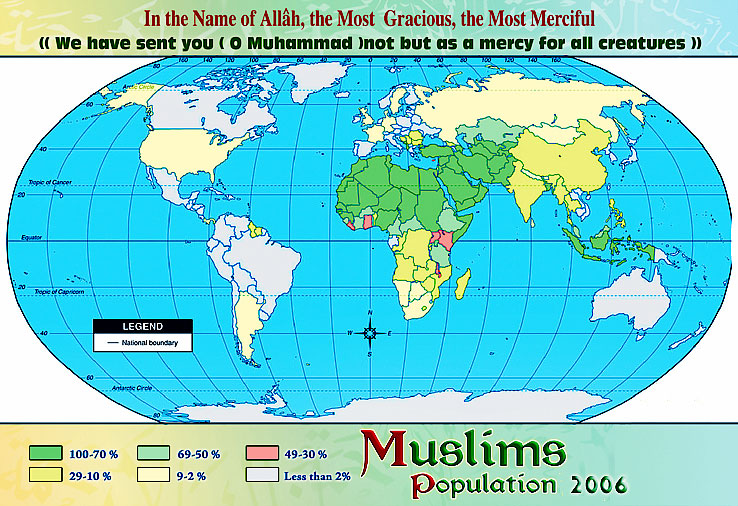
Modern Expansion of Islam


In fact, it is a wonder how Islam has spread today if we look at it in the context of the twenty-first century so far. With all the past regimes, both Eastern and Western, wanting to dominate the Middle Eastern home of all the major religions, one can only give credit to the Creator and those practicing Muslims who have taught us much.

In human terms, much has existed between the poles of domination and the liberty to practice one's faith, for it was only in the nineteenth century at the height of European colonial expansion that most of the Islamic world was colonized by the West. Some independence was gained by Arab states after World War I, but it was not until after World War II that further independence was gained with the breakup of colonial rule of European countries like Britain and France, with the exception of Muslim states within the USSR and Palestine, which over a period of time was partitioned into Jordan, Palestine, and Israel. During the same period, Indian Muslims had their own land in Pakistan and Bangladesh; Indonesia became independent from the Dutch, Malaysia from Britain, and later Nigeria, Senegal, Tanzania, and Brunei became independent.

However, among the relatively newly formed states, there has been a degree of secular rule as opposed to religious rule. Muslims from these regions were not only concerned with political independence, but also with their religious and cultural independence. Many reformers of Islam arose from the eighteenth century onwards, with Wahhabism in Saudi Arabia, the Sanusiyyah in North Africa, the Mahdi movement in Sudan, the Aligarh in India, and Iranian Jamal-ul-Din Al-Afghani in Cairo, who championed a pan-Islamism to unite the Islamic world politically as well as religiously. This was also in the context of a growing sense of nationalism after gaining independence from colonial rule. There was a growing sense of faith in the future (Barkati).

Yet other realities had to be faced, as they are still today, and that is the conflict between secular rule and being free to practice one’s religion. As a consequence, many Muslims over the past three centuries have migrated to Western shores seeking a better life, as many non-Muslims have done. Through the mechanism of migration and consequent interaction with non-Muslims, there has been the greatest exchange and thus expansion.

In Britain for example, the first bout of Islamophobia was during the Crusades. Yet despite that, friendships and allegiances were made. Queen Elizabeth I, for example, asked Sultan Murad of the Ottoman Empire for help against the Spanish. The first documented Englishman to convert to Islam was John Nelson in the sixteenth century, and among the aristocracy in the eighteenth and nineteenth centuries, there were converts like Sir Edward Montague, who was the son of the ambassador to Turkey. The first English translation of the Qur’an was published in 1649, and the first mosque in the United Kingdom was built in Wales in 1860.

Today, according to the BBC: "Over 600,000 of Britain's 1.5 to 2 million Muslims are active in their faith, which is a high proportion by Christian standards.…Most British Muslims belong to the Sunni tradition of Islam….There are over 600 mosques in the UK and around 60 Muslim schools" (BBC). Whereas the Islamic code of public conduct—made apparent by the apparel of women—might be considered antagonistic to some, for others, it makes them feel comfortable, as Muslim women are granted certain courtesies (e.g., English men give them a seat on public transportation when none is vacant). Hence one can see at all levels of secular society, a degree of positiveness has been made.

Born Muslims and Muslim converts interact with non-Muslims at the international, national, and local levels, in both government and civil society. In this way, non-Muslims who are open to learning on a multi-leveled basis come into touch with practicing Muslims whereby various forms of discourse take place. Also, within some sectors of secular Western society, there are those who have become dissatisfied with the deterioration of society and seek a more meaningful life and turn to Islam. Even in the midst of the propaganda machine of the “war on terrorism,” many conversions to Islam continue still, expanding the practice of the religion beyond territorial boundaries.

Allah and Islam Supporters

Islamic Sites

Aswat Al-Islam -- The sounds of Islam