
About Islam
“…And whosoever seeks a religion other than Islam, it will never be accepted of him and in the Hereafter he will be one of the losers.” (Koran: V 3:85)
Islam is the name of the religion that Muslims believe in. Islam is the religion of Muslims. In some parts of the world, two terminologies have been used to identify Islam and Muslims, namely: Mohammedanism and Mohammedans. These two words are considered to be misnomers as they give wrong impressions about Islam and Muslims. Its correct name is Islam, and the followers of the faith of Islam are called Muslims. The Arabic word Islam literally means “surrender” or “submission.” Islam means purity and submission to Allah, the one God, and to live in peace with the Creator, within one’s self, with other people, the environment and the whole Universe. Thus, Islam is a complete way of life, implying a total submission to Allah. The root of which is Silm and Salaam which means peace. Peace (Salaam in Arabic, Shalom in Hebrew) is achieved through active obedience to the revealed commandments of Allah, for Allah is the Just, the Peace.
The name Islam is universal in meaning. Islam is not named after a tribe of people or an individual, as Judaism is named after the tribe of Judah, Christianity after Christ and Buddhism after Buddha. Islam is not a name chosen by human beings; it was divinely communicated from Allah. Islam is a global faith, not of the East or West. It was not Muhammad but Adam who first bought Islam to humanity. Then, each Prophet and Messenger came to exhort the people to a clear understanding of Allah’s commandments. They offered teachings relevant to that time, until Allah chose the final prophet, Muhammad (may Allah peace and blessings of Allah be upon him), to come with the Last Testament referred to as the Koran.
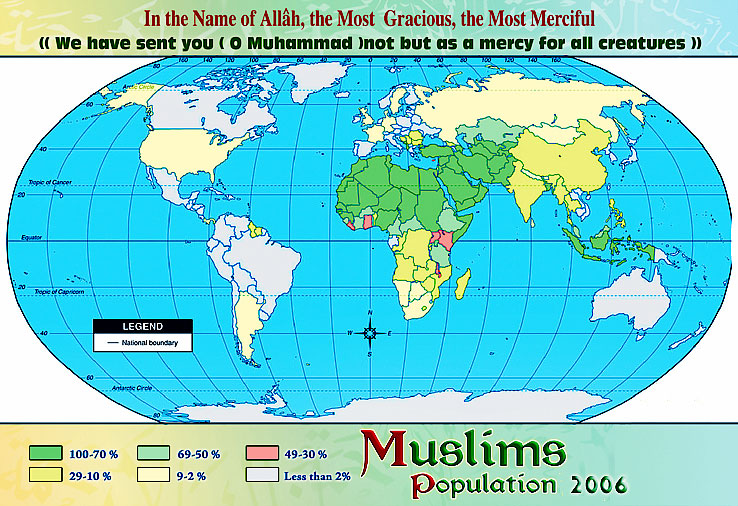
One who surrenders his or her will to Allah, voluntarily, is called a Muslim. A Muslim is supposed to live in peace and harmony with all these segments; hence, a Muslim is any person anywhere in the world whose obedience, allegiance, and loyalty are to Allah, the Lord of the Universe. As mention before the followers of Islam are called Muslims. Muslims are not to be confused with Arabs. Muslims may be Arabs, Turks, Persians, Indians, Pakistanis, Malaysians, Indonesians, Europeans, Africans, and Americans or may be from any other country or nationality. An Arab could be a Muslim, a Christian, a Jew, an agnostic, or an atheist. Any person who adopts the Arabic language is called an Arab. Nevertheless, the language of the Koran (the Holy book of Islam) is Arabic.
The purpose of Islam is to call people away from the worship of creation and to direct them toward the worship of The Creator alone. This is where Islam differs from other religions. Although most religions tech that there is a creator who created all that exists, they are rarely free of some form of polytheism (idolatry) with respect to worship. These religions either call on their adherents to worship other beings besides Allah (though usually placing these other gods on a lower level than the God who is The Creator), or they demand that their adherents call on other beings as intercessors between themselves and Allah.
All the Prophets and Messengers of Allah, from Adam to Muhammad, called people to worship Allah alone, without partner or intermediary. This is the purest, simplest, most natural faith. Islam rejects the notion held by cultural anthropologists that the early religion of human beings was polytheism which gradually evolved into monotheism. In fact, Muslims believe just the opposite, human cultures descended into idolatry during the intervals of time between the many Messengers of Allah. Even while the Messengers were among them, many people resisted their call and practiced idolatry despite their warnings. Subsequent Messengers were commissioned by Allah to bring people back to monotheism.
Islam being a heavenly system (or regime) for all the dwellers of the earth, and a mighty treasure if only mankind realizes its authenticity and truth. And in what a great need the whole world is today for ready understanding and thorough studying of its rules and regulations (i.e. Noble Koran and the pious Sunnah – legal ways, etc.) of the Prophet Muhammad (may Allah peace and blessings of Allah be upon him) as these (the Koran and As-Sunnah) accede to the demand of the people to know their Creator (the All Mighty Allah, the Blessed, the Most High); organize and regulate the relations between them on the foundations of (Godly) Divine Justice and equality; and respond to the human nature equally to that, which makes sure for them welfare (happiness) in this world and in the Hereafter after their deaths).
Islam is against aggression, sanction is given for war only in self-defense. “Fight in the way of Allah against those who attack you, but begin not hostilities. Verily, Allah loves not the aggressors. And if they (enemies) incline towards peace, incline you also to it, and trust in Allah.” (Koran)
There is no ground for the oft-repeated allegation that Islam is intolerant and was propagated by the sword. The Koran states clearly ‘there is no compulsion in religion’. It was only when her liberty and particularly her right of freedom or worship was threatened that ‘Islam seized the sword in self-defense, and held it in self-defense, as it will ever do. But Islam never interfered with the dogmas of any moral faith. It never invented the rack or the stake for stifling difference of opinion, or strangling the human conscience, or exterminating heresy.’ It has been alleged that a war-like spirit was infused into mediaeval Christianity by aggressive Islam! The massacres of Justinian and the fearful wars of Christian Clovis in the name of religion occurred long before the time of Muhammad.’ The conduct of the Christian Crusaders when they captured Jerusalem provides a striking contrast to the behavior of the Muslims when they occupied the city 600 years earlier.
When the Caliph Umar took Jerusalem, A.D. 637, he rode into the city by the side of the Patriarch Sophronius, conversing with him on its antiquities. At the hour of prayer, he declined to perform his devotions (prayers) in the church of the Resurrection, in which he chanced to be, but prayed on the steps of the church of Constantine; “for”, said he to the Patriarch, “had I done so, the Mussulmans in a future age might have infringed the treaty, under color of imitating my example.” But in the capture by the Crusaders, the brains of young children were dashed out against the walls; infants were pitched over the battlements; men were roasted at fires; some were ripped up, to see if they had swallowed gold; the Jews were driven into their synagogue and there burnt; a massacre of nearly 70,000 persons took place, and the Pope’s legate were seen partaking in the triumph!
And how many disasters, calamities and wars, the mankind of the whole world is suffering because of their differences in faith, and organizations, which have broken them into the worst type of breaking, so there remains no way out for any security or any safety or any peace except with Islam, (i.e., by putting in practice the Laws of the Creator, Allah).
Invitation to Islam is incumbent upon all those who have known it, and have enjoyed its taste and have been guided through its guidance. In fact, it is a great responsibility and a trust (of Allah) over (the shoulders of) all those who know Islam, to preach it to mankind and invite them to it in a language they speak and understand.


Islamic Sites











 Posts
Posts

